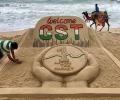
GST collections in February grew 18 per cent to over Rs 1.33 lakh crore in February even as the Omicron wave dented the month-on-month collection momentum. This is for the fifth time in the current fiscal that the Goods and Services Tax (GST) collection has crossed Rs 1.30 lakh crore mark. Also, this is the first time, cess collection has crossed the Rs 10,000 crore mark, signifying recovery in certain key sectors, especially automobile sales, the finance ministry said on Tuesday.
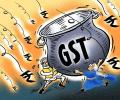
GST collection rose 11 per cent to over Rs 1.65 lakh crore in July as a result of anti-evasion measures and higher consumer spending. This is the fifth time since the rollout of the Goods and Services Tax (GST) regime that monthly collections have crossed the Rs 1.60 lakh crore mark -- making it the new normal. "Gross GST revenue collected in July is Rs 1,65,105 crore of which CGST is Rs 29,773 crore, SGST is Rs 37,623 crore, IGST is Rs 85,930 crore (including Rs 41,239 crore collected on import of goods) and cess is Rs 11,779 crore (including Rs 840 crore collected on import of goods)," the finance ministry said in a statement.

Union Finance Minister Nirmala Sitharaman on Tuesday said the mass consumption items such as pulses, wheat, rice, flour, and curd will not attract the 5 per cent goods and services tax (GST) when sold loose, and not pre-packed or pre-labelled. The clarification came amid protests and widespread criticism by Opposition Members of Parliament over foisting GST on daily-use essentials and subsequent price rise. The all-powerful GST Council, chaired by the Union minister, had last month decided to impose GST on some mass consumption items to simplify the rate structure, which came into effect on Monday.

GST collections in March slipped below the psychological Rs 1-lakh crore mark for the first time in four months to Rs 97,597 crore as the COVID-19 lockdown that shut most businesses compounded tax collections in an already sluggish economy.

The total gross GST revenue collected in the month of June, 2019 is Rs 99,939 crore

The GST Bill, seen as single biggest tax reform in a long time, needs to be ratified by at least 15 state legislatures before the President can notify the GST Council which will decide the new tax rate and other issues

As cess levied under GST isn't shared by states, most states oppose it on the ground that it would set a wrong precedent and distort the GST structure.

To those who ask, "Is all this really worth it? Why can't domestic demand fill the gap?", it is important to remind them that only 13 economies since the Second World War have grown at 7 per cent or more for 25 years -- like India needs to. They all had one thing in common: Strong export growth underpinned by strong global engagement, explains Sajjid Z Chinoy.

Revenue from Goods and Services Tax (GST) stood at over Rs 1.04 lakh crore in November as against Rs 1.05 lakh crore collected in the previous month, the Finance Ministry said in a statement. This is the second straight month in the current fiscal when GST revenue has topped Rs 1 lakh crore. The collection in November 2020 is 1.4 per cent higher than in November 2019 when the GST mop-up was Rs 103,491 crore.

Bajaj Finance, IndusInd Bank, State Bank of India, Maruti, Tata Motors, ITC, Tata Steel and Reliance Industries were also among the gainers. Nestle, NTPC, Kotak Mahindra Bank, Power Grid and Titan were among the laggards.

'You've got to understand it is not easy to die by suicide.' 'People commit suicide only when they lose everything and find no other way to live.'
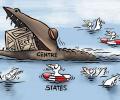
States may face a GST compensation shortfall of Rs 3 lakh crore in the next financial year, a situation that will force them to borrow more from the markets, says a report. The states may face a shortfall of Rs 2.7-3 lakh crore as Goods and Services Tax (GST) compensation from the Centre next fiscal. Out of that amount, the shortfall from cess collections will be at Rs 1.6-2 lakh crore, according to an Icra report released on Monday. In FY21, the states were facing a shortfall of Rs 1.1 lakh crore in GST compensation from the Centre but over 90 per cent of that amount has been cleared now.

The Centre has borrowed and transferred Rs 6,000 crore as the first tranche of GST compensation shortfall to 16 states and two union territories, including Maharashtra, Gujarat, Bihar, Assam, Delhi and J&K, the finance ministry said on Friday. Last week, the Centre gave in to the demands of opposition-ruled states to borrow and fund the GST compensation shortfall.

The panel of state finance ministers is likely to recommend a uniform GST levy of 28 per cent on online gaming irrespective of whether it is a game of skill or game of chance, sources said. However, it is likely to suggest a revised formula for calculating the amount on which the Goods and Services Tax (GST) would be levied. Currently, online gaming attracts 18 per cent GST.

'The quality of justice is directly linked to the quality of judges -- if that suffers, justice delivery suffers.'

The Centre on Thursday placed before the GST Council two options for borrowing by states to meet the shortfall in GST revenues, pegged at Rs 2.35 lakh crore in the current fiscal.

Compliance requirements, valuation, input tax credit transfers are likely to lead to tax litigation, says Sayan Ghosal.
India's GST collection remained above Rs 1 lakh crore for the third month in a row at over Rs 1.17 lakh crore in September, raising expectations that second half of the year will post higher revenues. The tax collections in September on goods sold and services rendered was 23 per cent higher than Rs 95,480 crore collected in September 2020, and 27 per cent higher than Rs 91,916 crore collected in September 2019. The collection in September is the highest in five months since April, when revenue was at record high of Rs 1.41 lakh crore.

The Bill was introduced in the Lok Sabha in December.

Online sports platform Mobile Premier League has laid off around 350 people or about half of India team to cut down on expenses and bear the burden of increased GST of 28 per cent, according to an internal company email. The GST Council has decided to levy a 28 per cent GST on online gaming and casinos on the face value of bets at the entry level. The Centre will bring amendments to the Central GST law in the ongoing monsoon session of Parliament, following which states will pass the amendments in their respective assemblies to pave the way for the introduction of changes in the law by October 1.

The governments of Karnataka, Uttar Pradesh and Rajasthan want a lower limit of Rs 100,00,00 gross annual turnover.

The finance ministry on Monday said it will transfer Rs 6,000 crore as the second tranche of GST compensation shortfall to 16 states and 3 Union Territories -- including Maharashtra, Bihar, Assam, Puducherry and Delhi. The Centre had on October 23 transferred Rs 6,000 crore to 16 states and 2 UTs of Delhi and Jammu and Kashmir. In the second tranche of transfer, Union Territory of Puducherry has been included.

Foreign companies now pay less tax relative to their earnings than at any time in more than three decades. Foreign private companies paid 24.36 per cent of their pre-tax profit as tax in 2023-24, show numbers from the Centre for Monitoring Indian Economy (CMIE).

States' demand for 5 years and Constitutional provision ruled out

The Centre on Tuesday permitted 20 states to raise Rs 68,825 crore through open market borrowings to bridge the GST revenue shortfall.
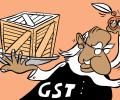
Overhaul of the goods and services tax (GST) structure, including possible changes in the tax slabs, may now be taken up only after the 2024 Lok Sabha elections, given the number of states that are going to the polls in its run-up. "No major overhaul of tax rates is expected in GST until the end of next fiscal year. One major reason for this is that some members of the group of ministers (GoM) - mandated to look at rate rationalisation by the GST Council - are from poll-bound states. Later, this may lead to reconstitution of the panel," a senior government official told Business Standard. Besides, both the Centre and states are not in favour of frequent changes in the tax rates amid inflationary uncertainties; they believe any major change should be brought in after extensive deliberations, according to the official.
Six years after the rollout of the biggest indirect tax reform in India, Goods and Services Tax (GST) revenue of Rs 1.5 lakh crore every month has become a new normal and tax officers are focusing on dealing with fraudsters who are adopting newer modus operandi to game the system, causing loss to the exchequer. To apprehend black sheep, who operate as syndicates and create fake entities on the basis of forged documents to claim input tax credit (ITC), tax officers have started using data analytics, artifical intelligence and machine learning aiming to curb evasion, which was over Rs 3 lakh crore since inception of GST. It was over Rs 1 lakh crore in 2022-23. Thinktank Global Trade Research Initiative (GTRI) said the most critical pending GST reform is upgradation of GST Network to prevent fake supplies and fraudulent claims of Input Tax Credit (ITC).
The states have unanimously pitched for sole administrative powers to carry out assessment, scrutiny and enforcement for entities up to an annual turnover of Rs 1.5 crore.

This may leave those not opting for any of the two options offered by the Centre before the GST Council meet scheduled for October 5 in the lurch. It is clear from the present situation that these states will have to wait till June 2022 to get their compensation, subject to the council extending the cess collection period beyond June 30, 2022.

While demand for sub Rs 50-lakh affordable housing prevails, market players cite increased land rates, escalated construction costs and low margins as key prohibiting factors.

The passage of the bill will pave the way for setting up of a GST council that will decide the tax rate, cess and surcharges.

The Madhya Pradesh government on Monday presented an alternative model of the GST but some states immediately raised objections to it.

At a meeting of the Empowered Committee of State Finance Ministers, the Centre's plan to bring petroleum goods under GST regime was opposed.
The Centre is likely to introduce the Central GST and integrated GST bills in late November or early December in the ongoing session in the form of money Bills.

As the Centre tried to build consensus on its proposal on constitution amendment bill, required for the rollout of GST, and even floated revised draft to please states, some states came out with alternative model that would not require the amendment of constitution.
The change in the peak rate will not alter the 4-slab rate structure of 5, 12, 18 and 28 per cent agreed upon last year, but is only a provision being built into the model law to take care of contingencies in future, two officials in the know told PTI.

Inching towards rolling out of GST, the GST Council on Saturday approved a law to compensate states for any loss of revenue from the implementation of the new national sales tax but deferred approval for enabling laws to next meeting.

From the 30-share pack, Bajaj Finserv, Mahindra & Mahindra, Eternal, Power Grid, ITC, Tata Motors, Asian Paints and Hindustan Unilever were among the gainers. Among the laggards, Kotak Mahindra Bank tanked 4.57 per cent

The government has decided to compensate states for any revenue loss on account of the implementation of the Goods and Services Tax (GST), a move that will encourage states to go in for the new tax structure scheduled to be implemented from April 1, next year.

The panel might also decide on a new chairman.
